At Castle Primary School, we believe that history is the study of the past and the changes that have occurred within human societies over time. Through the study of history, pupils develop an understanding of how the world we live in today has been shaped by people, events, ideas and civilisations from the past. We aim to inspire curiosity, encourage critical thinking and help children understand both their local heritage and their place within a wider historical narrative.
Our history curriculum is built around the teaching of both substantive knowledge (what pupils learn about the people, events and periods of the past) and disciplinary knowledge (how historians investigate, interpret and understand the past). Through enquiry, discussion and the careful analysis of sources, pupils learn to think and work as historians, asking questions, evaluating evidence and forming reasoned conclusions.
We have carefully designed a spiral curriculum that enables pupils to revisit and deepen their understanding of historical concepts throughout their time at Castle Primary School. In Key Stage 1, pupils begin to explore the concepts of Change, Significance, Similarity and Difference, Evidence, and Exploration and Discovery. In Key Stage 2, learning is organised around nine key historical concepts: Community and Culture, Conflict and Disaster, Exploration and Invention, Hierarchy and Power, Cause and Consequence, Change and Continuity, Similarity and Difference, Evidence and Interpretation, and Significance. These concepts provide the lens through which pupils explore different periods of history, enabling them to make increasingly sophisticated connections across their learning.
Historical enquiry is at the heart of our curriculum. Each unit is driven by carefully planned enquiry questions that encourage curiosity, challenge assumptions and develop analytical thinking. Pupils investigate the past through a range of sources and evidence, considering different interpretations and evaluating how historical knowledge is constructed. Through carefully planned opportunities for retrieval, pupils revisit prior learning and vocabulary, strengthening understanding and supporting long-term memory.
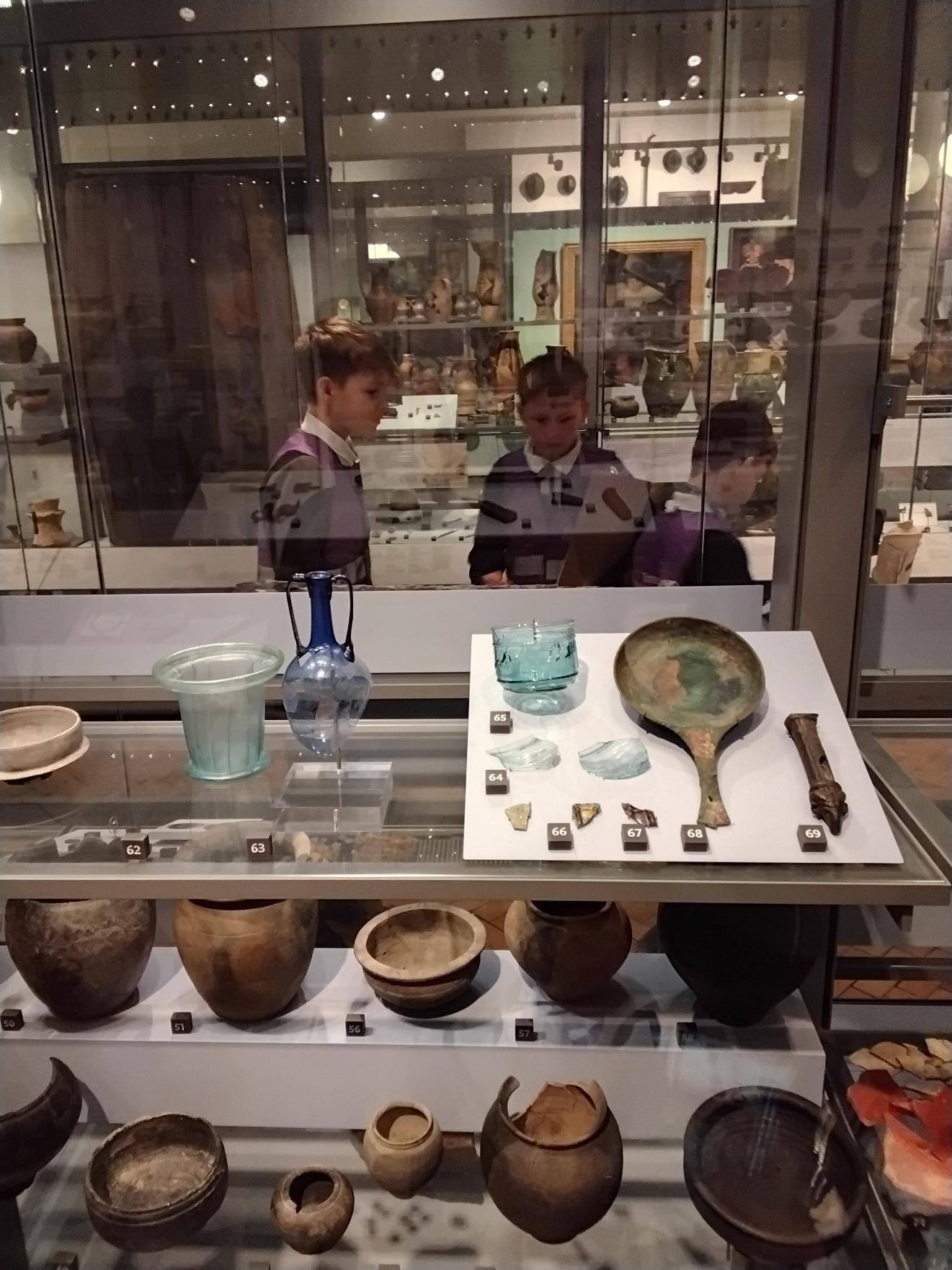
We believe history should be experienced as well as studied. Wherever possible, pupils engage with history through educational visits, visitors and hands-on experiences that bring the past to life. Pupils have opportunities to explore artefacts through topic boxes, visit local museums and heritage sites, and learn from expert visitors who enrich classroom learning through immersive experience days. Our whole Key Stage 2 visit to RAMM (Royal Albert Memorial Museum and Art Gallery) in Exeter allows pupils to engage with historical artefacts and use virtual reality technology to deepen their understanding of historical periods and events.
Our curriculum places a strong emphasis on local history, enabling pupils to develop a sense of place and understand how their community has evolved over time. By studying the history of the local area alongside significant national and world history, pupils develop an appreciation of how local, national and global events are interconnected.
Vocabulary development is carefully planned and sequenced throughout the curriculum. Pupils revisit and apply previously taught historical vocabulary whilst acquiring new subject-specific terminology, allowing them to discuss historical concepts, events and interpretations with increasing confidence and precision.
Through the study of a diverse range of people, civilisations and time periods, pupils develop an understanding of different cultures, beliefs and experiences across history. They learn to recognise the complexity of the past, appreciate different perspectives and understand how historical events continue to influence the modern world.
By the time pupils leave Castle Primary School, they will:
Have a secure understanding of key historical concepts, knowledge and chronology.
Think and work as historians through enquiry, investigation and analysis.
Use evidence and sources critically to develop and justify their ideas.
Understand how and why interpretations of history may differ.
Apply precise historical vocabulary to explain and communicate their understanding.
Make meaningful connections between local, national and global history.
Understand how the past has shaped the society and world in which they live today.
Ultimately, our history curriculum aims to inspire curiosity about the past, develop informed and reflective learners, and equip pupils with the knowledge and analytical skills needed to understand both history and the world around them.

|
Year 3 4 History 26 27 | [pptx 32MB] |

|
|
|
Year 5 History 26 27 | [pptx 4MB] |
|
|
|
Year 6 History 26 27 | [pptx 1MB] |
|
|
|
Year 1 2 History 26 27 | [pptx 1MB] |
|
|
|
Whole School History Curriculum | [pptx 504KB] |
|

|
Castle History Skills Progression | [docx 74KB] |
|
|
|
Sample History MTP History of Nurses | [docx 252KB] |
|